The Girya
A Russian market counterweight with a handle, used for weighing goods long before it was used for anything else.
A weight before it was a workout
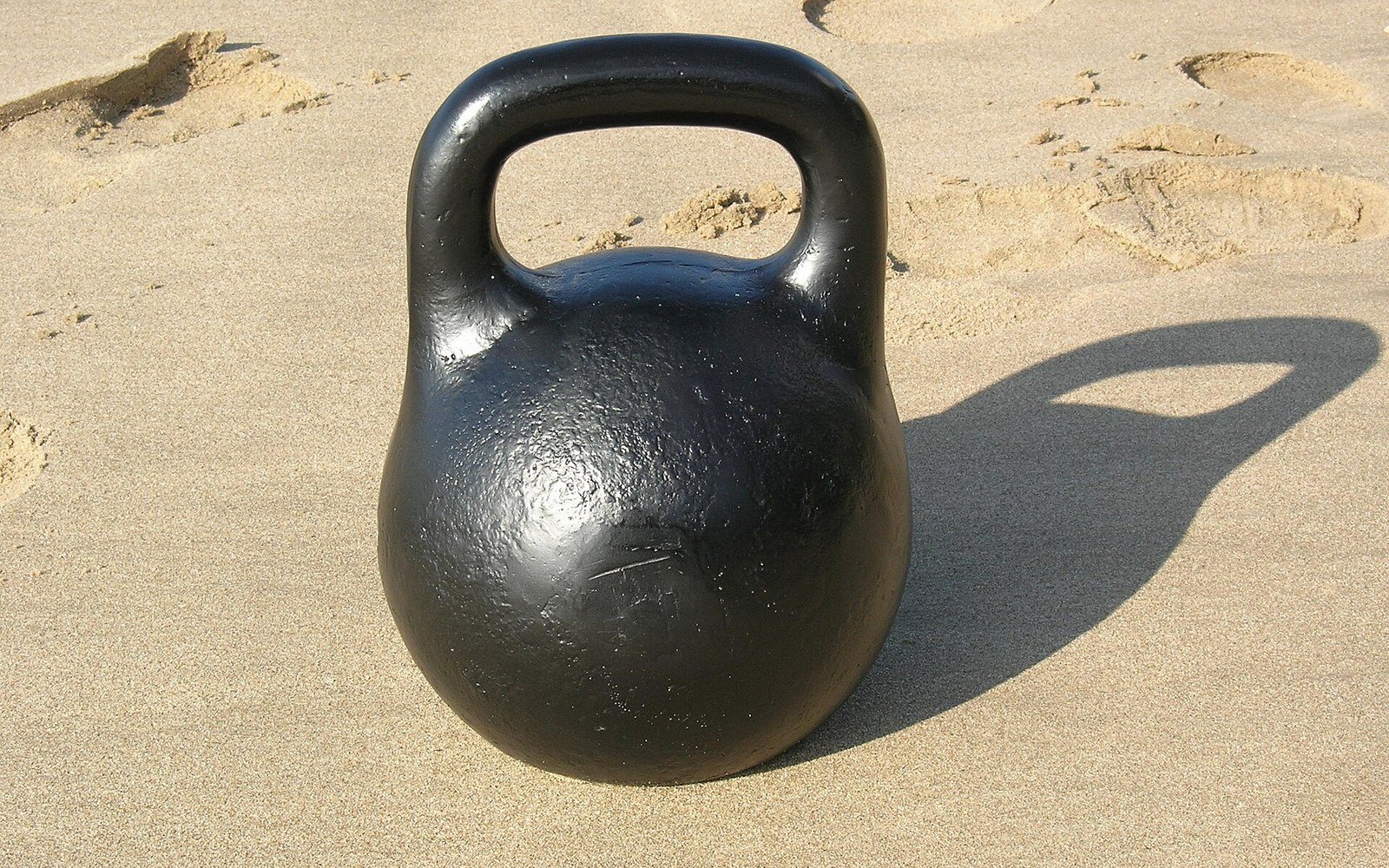
The girya (гиря) is a cast-iron sphere with a handle, and it spent most of its early life in commerce, not competition. Russian market traders used it as a counterweight on balance scales — a standard mass against which goods were weighed, sold and taxed. The handle was a practical feature: it let a merchant hook the weight onto the scale arm or shift it between stalls without dropping it. Nobody exercising enters the picture for quite some time.
The word itself is thought to derive from a Turkish or Persian root for a unit of weight, which points toward the trade routes and influence that shaped the markets of the Russian empire. The object was simply a piece of certified infrastructure, sitting on a platform scale beside sacks of grain or bales of cloth. Its spherical shape was efficient to cast, easy to store and difficult to counterfeit by shaving — an irregular lump is easy to defraud; a smooth sphere of known alloy is harder.
Measures and standards
| One pood | approximately 16.38 kilograms; the traditional Russian unit of mass the girya was built around |
|---|---|
| One pood, 1.5 poods, 2 poods | the three common competition sizes that emerged from Russian practice |
| Two-pood girya (≈ 32 kg) | the benchmark weight in modern girya sport |
From the market stall to the fairground
Russian and Eastern European market fairs were crowded with performers as well as traders, and the boundary between showing off and commerce was always porous. Strongmen who worked the fair circuit found the girya close to hand — literally a prop that was already there — and began using them as demonstration weights. Lifting a heavy girya overhead, passing two between the hands, or pressing one at arm's length while someone stood on the lifter's back: these were entertainments that drew a crowd, which drew buyers, which was the point of the fair.
By the later nineteenth century, the girya had migrated from commerce into organised strength culture. Russian military authorities took note; there are documented references to girya use in physical conditioning within the imperial Russian army in the 1880s and 1890s. The All-Russian Athlete Society held lifting competitions of various kinds, and the girya sat alongside other implements of the period — barbells, dumbbells, rings and bars — as one of several objects used to define and demonstrate strength.
The standard weights that emerged in Russian practice were defined in poods, the traditional Russian unit of mass. One pood is approximately 16.38 kilograms. The most common competition sizes were one pood, one and a half poods and two poods — the two-pood girya, at roughly 32 kilograms, becoming the benchmark that persists in the sport today. These round figures were not arbitrary: they mapped onto existing commercial weight standards, because the girya on the scales and the girya on the fairground platform were the same object, made by the same foundries.
The object itself
What distinguishes the girya from a dumbbell or a kettlebell of later design is the relationship between the ball and the handle. The mass is low and off-centre relative to the grip; when lifted, pressed or swung, the weight moves in a way that a symmetrical dumbbell does not. The handle must be large enough for a full hand, and its curve determines how the ball rests against the forearm and wrist. Early cast-iron examples were made in single-piece moulds, which meant the handle thickness and the sphere diameter were fixed together — you could not adjust them. This is why vintage giryas vary noticeably in handle proportion depending on their foundry, region and date, even when the nominal weight is the same.

Soviet-era standardisation brought more uniformity. The sport of girevoy (гиревой спорт, girya sport) developed formal rules through the Soviet period and was eventually organised under national federations. The World Kettlebell Club and related international bodies now govern competitions conducted with implements that are essentially the same shape the market trader was hooking onto a scale arm two centuries ago.
That is the quiet strangeness of the object: it outlasted the balance scales, the pood, the market fairs and the empire that certified its weight. The handle is still there because a merchant needed to move it quickly, and it turns out that a ball of iron you can hold in one hand is useful for a great many things the merchant never intended.