The Dinnie Stones
Two iron-ringed granite blocks, a bridge on Deeside, and a story that has outlasted every attempt to pin it down precisely.
What they are
They sit at Potarch, a small crossing on the River Dee in Aberdeenshire, and they are unmistakably themselves: two chunks of Deeside granite fitted with wrought-iron rings, together weighing around 332 kilograms — though the precise breakdown between the two stones varies slightly depending on which modern weighing you trust. The larger, known simply as the larger Dinnie Stone, carries the greater share of that mass; the smaller is still substantial enough to be interesting on its own terms. Neither has a grip in any useful sense. The rings pass through iron staples sunk into the granite, and they are not generous in their dimensions. A lifter taking both stones simultaneously closes their hands around those rings and finds them low, forcing a deep bend, the stones hanging beside each foot. The geometry is the point. This is not a shape that flatters strength; it is a shape that interrogates it.
The stones were almost certainly set-stones — boundary or gate weights of the kind common on Scottish estates — before they became objects of contest. That functional origin matters. They were not made for lifting, which is precisely why lifting them became a measure. The iron rings are not lifting handles; they are working fittings from a working object, and they set the terms of every attempt that has followed.
The object itself
| Potarch, Aberdeenshire | location of the stones; custodied by the Potarch Hotel |
|---|---|
| Total combined weight | approximately 332 kg; two stones of unequal mass fitted with wrought-iron rings through iron staples |
| The rings | not designed as lifting handles; functional fittings repurposed by tradition |
| Set-stones | the likely original function, as boundary or gate weights on a Scottish estate |
Donald Dinnie and the carry at Potarch
Donald Dinnie was a nineteenth-century Scottish athlete from Birse, Aberdeenshire, who competed across the full range of Highland Games disciplines — hammer, caber, shot, wrestling — for a career that ran across several decades from the 1850s onward. He was not a single-event man but a points accumulator, and his reputation was built on consistency and longevity as much as any single feat. He won at Braemar and at gatherings across Scotland and beyond, and he toured professionally in a way that would look recognisable today: strength as spectacle, promoted and witnessed.
The story attached to the stones at Potarch holds that Dinnie carried both of them simultaneously across the width of the bridge at Potarch, in 1860, gripping the rings with each hand, the stones hanging beside his legs for the duration of the crossing. The distance is sometimes cited at around 5.2 metres, though this figure, like the 1860 date, rests on tradition and repeated assertion rather than contemporary documentation. There is no verified eyewitness account from 1860 that historians have been able to point to; the story propagated through Dinnie's own considerable self-promotion, through local oral tradition, and through the retelling that athletic celebrity always generates. As with many feats of this era, the absence of documentation is not the same as evidence of fabrication — record-keeping at rural Highland Games was inconsistent, and remarkable things happened without a clerk in attendance — but the distinction between a documented achievement and a traditional one is real, and it matters. The carry at Potarch is famous. It is not proven.
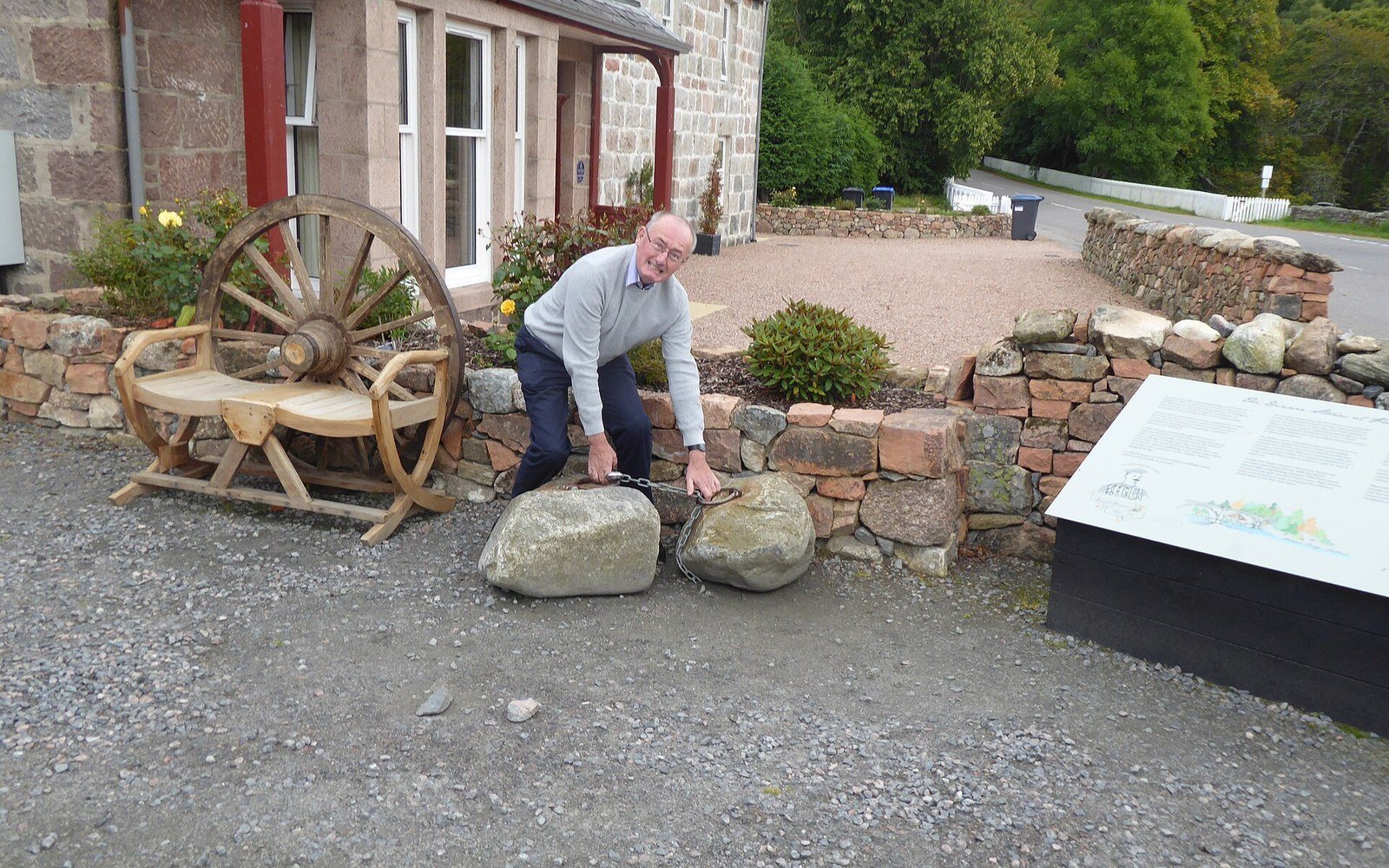
What is not in doubt is that Dinnie became the name attached to these specific stones, that they were used in competition and challenge for well over a century, and that they function now as a fixed point in the landscape of heavy stone tradition — an object with a biography even if that biography contains gaps.
After Dinnie
The stones passed into the care of the Potarch Hotel, where they have been kept and brought out for those who make the journey specifically to attempt them. That arrangement — local custodianship, stones available by appointment rather than on permanent public display — is characteristic of objects in this tradition. The stones belong to a place, and the place is part of the point.
For most of the twentieth century the stones were an esoteric challenge known mainly to those already embedded in Scottish strength culture. That changed with the spread of strongman competition from the late 1970s onward, and the simultaneous growth of a community interested in traditional lifts and their documentation. The Highland Games revival, the emergence of televised strongman, and the internet's capacity to move footage of unusual feats all enlarged the audience for objects like the Dinnies. Competitors began travelling from outside Scotland, then from outside Britain, to attempt a carry — a pattern that now parallels what happens at Húsafell in Iceland.
One of the more documented modern carries belongs to Jón Páll Sigmarsson, the Icelandic strongman and multiple World's Strongest Man champion, who carried the stones at Potarch. His attempt, unlike the 1860 tradition, occurred in an era of video and witnesses. Whether this constitutes the same event that Dinnie performed — same stones, same place, broadly analogous movement — or something different shaped by different context and expectation is a question the stones cannot answer. They are inert granite. They do not adjudicate.
What they represent
The Dinnie Stones occupy an unusual position among traditional lifting objects because they are neither purely natural nor truly standardised. They are not quarried and shaped to a specification, but neither are they simply boulders sitting in a field. The ironwork converts them into instruments of a kind — objects modified for human use, even if not for lifting specifically — and that modification is part of their character. As a pair they create a bilateral challenge with no analogue in Atlas Stones competition or in barbell lifting: the weight is divided, the grip is fixed by ring dimensions neither party chose, and the lifter cannot adjust his relationship to the load.
That irreducibility is what keeps them interesting to people who are not primarily interested in strength sport but in the specificity of objects. The Dinnie Stones weigh what they weigh because two particular pieces of granite were fitted with iron rings at some point in the nineteenth century, probably for entirely practical reasons, in Aberdeenshire. They are not a round number. They are not designed. They are themselves, and there is only one pair.
The story that grew around them — Dinnie, the bridge, 1860, five metres of carry — may be imperfectly documented, but it performed the work that stories perform: it made the objects memorable, it gave people a reason to travel to Potarch, and it ensured that the stones were preserved rather than lost. In the long history of heavy things that were simply thrown away, that is not nothing.